

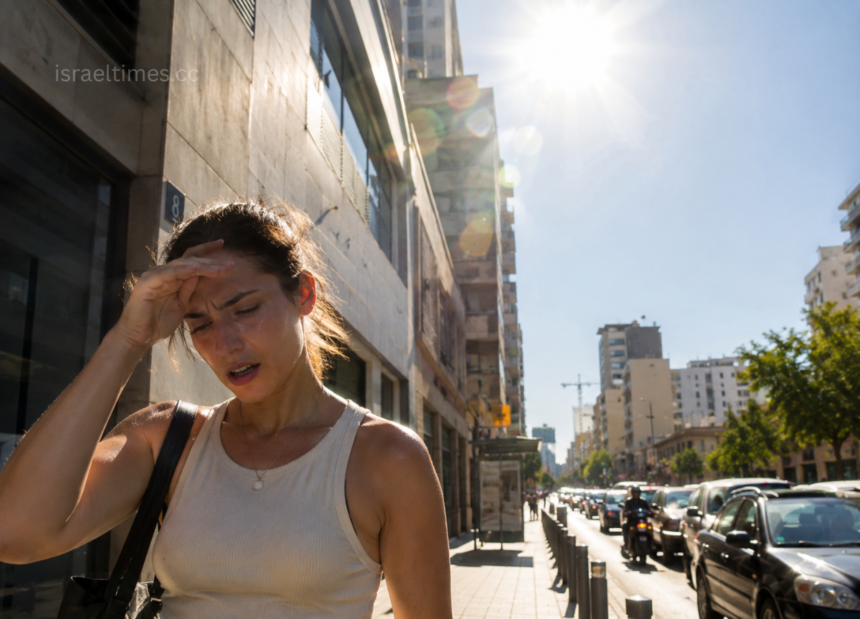
Rising summer and winter temperatures are increasing public health and environmental dangers in Israel’s largest metropolitan area, revealed in recent scholarly research on urban heat islands in Gush Dan. Thermal disparities in urban zones and commercial hubs have been observed to rise up to 4 degrees warmer in summer and 9 degrees warmer in winter than the surrounding countryside. Central Israel urban heat hazards
The study reveals how fast urbanisation and architecture increase climate threats for the region. One of the most urbanised countries in the Mediterranean region, where 93% of the population lives in urban areas, Israel is increasingly vulnerable to climate change.
Global climate data designates the country as a major environmental hotspot, with local temperatures rising faster than international benchmarks.
Researchers from the Holon Institute of Technology and Tel Aviv University tracked environmental data from satellites, meteorological monitoring stations, and infrared measurements. Their study, published in the journal Urban Climate, discovered that microclimatic heat retention varies significantly based on density, landscape features, and diurnal cycles.

The highest thermal loads occur within industrial sectors, compact mid-rise neighbourhoods, and densely built municipalities such as Bnei Brak, Holon, Bat Yam, Ramat Gan, Rehovot, and parts of south Tel Aviv. Dense concrete structures, a scarcity of natural shade, and extensive dark surfaces retain solar radiation, trapping intense ambient heat. In contrast, low-density districts with greater foliage, such as Old North Tel Aviv, maintain lower baseline temperatures.
The spatial distribution of trapped heat shifts continuously throughout the day. Coastal wind flows and Mediterranean sea breezes drive heat retention eastward during daytime hours before thermal currents shift back toward the coastline overnight. While summertime walking-level air temperatures experience the largest variation between city and countryside, ground-level surface heat shifts more dramatically during winter nights when open rural land rapidly radiates stored energy away.
Addressing these microclimatic variations requires immediate intervention from municipal authorities and urban planners. Integrating reflective building materials, expanding urban canopy coverage, and modernising infrastructure are essential steps to mitigate localised thermal stress as Middle Eastern metropolitan centres adapt to escalating regional climate impacts. Isreal Times