

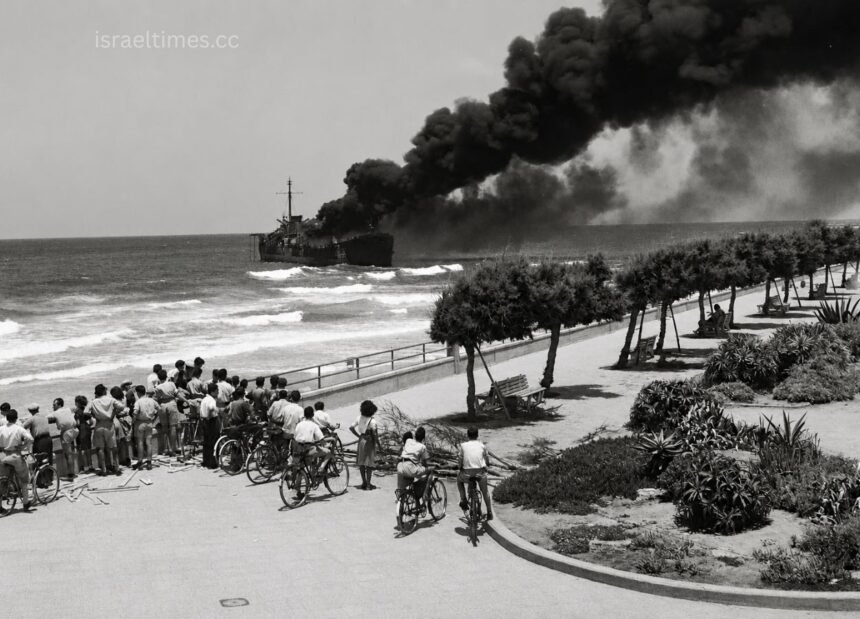
The discovery of the wreckage of the Altalena – the famed cargo ship that served as a focal point of arguably the most difficult and defining confrontations in the early days of Israel – in an almost perfectly preserved state at a depth of 503 metres has put an end to the ongoing, almost eight-decade-long search for the ship.
The historic discovery was announced officially by National Security Minister Itamar Ben-Gvir and Heritage Minister Amichai Eliyahu, who were part of a covert and months-long offshore exploration mission that identified the exact location of the wreck. The mission used an advanced research vessel fitted with high-resolution underwater detection systems.

Officials emphasised that locating the ship closes a significant historical circle surrounding one of the most tragic moments in the country’s early statehood.
The Altalena arrived off the coast of Israel in June 1948 during the Arab-Israeli War, carrying over 900 Jewish immigrants alongside a massive cache of weapons and military hardware dispatched by the Irgun (Etzel) underground paramilitary group. However, intense political disagreements over the distribution and control of the arms cache triggered a fierce confrontation between the newly formed Israel Defense Forces (IDF) and Irgun combatants. Acting under the strict authority of Prime Minister David Ben-Gurion to establish a single unified national army, IDF units fired upon the vessel off the coast of Tel Aviv.
The ensuing firefight and shelling resulted in the deaths of 16 Irgun members and three IDF soldiers, threatening to plunge the nascent nation into a destructive civil war. The crisis was ultimately averted when Irgun leader Menachem Begin famously ordered his followers to refrain from retaliating against fellow combatants. The vessel eventually burnt, sank, and lay undisturbed on the seabed for 78 years.
Government representatives confirmed that comprehensive underwater mapping data, high-definition deep-sea imagery, and updated historical research will be presented during an official state press conference. The discovery offers overdue closure for historians, families of the fallen, and the broader public regarding a pivotal chapter in the region’s modern heritage.